
H2O2, Oil of Oregano, Clotrimazole
★★★★★

It started with an itchy red bump at the left side of my nose - it would clear scab over but wouldn't heal. I remembered my parents had BCC and used an ointment to treat it, and so here I arrived at my go-to site looking for a symptom set and natural remedy.
I treated the bump with H2O2 quite successfully within 2 weeks, but noticed there were other itchy bumps and inflamed spots and so I dug those up with H2O2. They were bigger and deeper. And took longer to heal. My face was on fire. Sometimes the lesions would close over but I could tell from the remaining surrounding inflammation and the tenderness or sharp pain that they were not fully "excavated". I would dig in a little bit with the H2O2 and yup - still there.
After about eight weeks I had cleared areas on about 60% of my face, but the last 40% was just agony. I felt like I was chasing this thing all over my face - no sooner had I cleared a pocket than one just a centimeter away would start to inflame and itch, and a light rub with H2O2 would show a large area of abnormality.
The scabbing and peeling was, I gotta say, monstrous. I haven't had this kind of skin since my acne-infested teens.
I felt like I was missing something.
I read up on oil of oregano to see if it was effective against BCC. Yes, it is. Also coconut oil. Yup that too. I began to treat the most stubborn open lesions with oregano oil and within a week, saw improvement.
I began to reflect on what I know about H2O2, oil of oregano and coconut oil.
First of all - H2O2. If you watch any science youtube content, it talks about how it "explodes" mico-organisms. These are living things that are super-oxygenated and just go "poof" and create the foam. And I was thinking, wait a minute. The BCC cell is abnormal - but WHY is it abnormal? Sure it has sun damage. There's something wrong with its functioning. But H2O2 doesn't make a healthy cell foam. So is there something inside the BCC cell that explodes?
Then I thought about oil of oregano. It is effective against three things: viruses, bacteria and fungi. Why would it be effective against a malfunctioning skin cell? It is neither a bacteria, nor a virus nor a fungus. UNLESS one of those things is living rent free inside the cell. THEN maybe there's a reason why it might kill the cell, or the thing inside it. if it exists.
Then I looked at coconut oil. Is it a fungicide? Why yes it is. It's used as part of treatment against a candida overgrowth. Also I looked at various remedies - the ketogenic diet for instance inhibits the proliferation of candida albicans.
Then I looked at the BEHAVIOUR of this thing, and it was behaving like a plant. You know when you cut off a small outgrowth of a plant, suddenly it responds with a burst of energy and branches out in all directions from the injured part?
I started with a tiny speck on one cheek and within eight weeks my face was covered in weeping lesions, as new spots grew out next to the healed ones.
So I put 2 and 2 together and thought - OK. What if this is a kind of fungus? Some kinds of fungus only grow on bread. Others only grow on toenails. What if there's a KIND of fungus that only grows in sun-damaged skin cells? Mybe we don't know what t is, but why are antifungal treatments so effective against BCC?
So. I started to treat the remaining open lesions with over-the-counter clotrimazole. Within a week, lesions that had been open for six weeks were closed, healed over, and non-inflamed.
I began to treat the small bumps that were arising next to the healed lesions directly with clotrimazole, without opening them up with H2O2. I opened one or two just to be certain, though. Within a week, they had disappeared, but the skin that was sloughing off showed circular pit-shaped "holes" where a fungus had once existed.
So now I'm moving on to some itchy bumps under some of my sun spots on my arms and torso.
Today I had an experience where I was swimming in the sea and there are small fish that will come and nip at your skin. It's ticklish and hilarious. But one was attacking some part of my foot, really giving it a kind of "tearing" effort. I was like "Whoah little dude. What the heck do you see here?" I put my finger to the spot and it was a tiny, almost imperceptible bump. Later I sterilized the area and gave it a good rub with H2O2 and what do you know? It foamed like a champ. Made me wonder what kind of spectrum these little fish actually see. I mean, it was invisible to the eye, barely perceptible to the touch, but that little fish saw "DINNER".
ANyway, that's my story. I hope it helps someone.
Flush Niacin
★★★★★
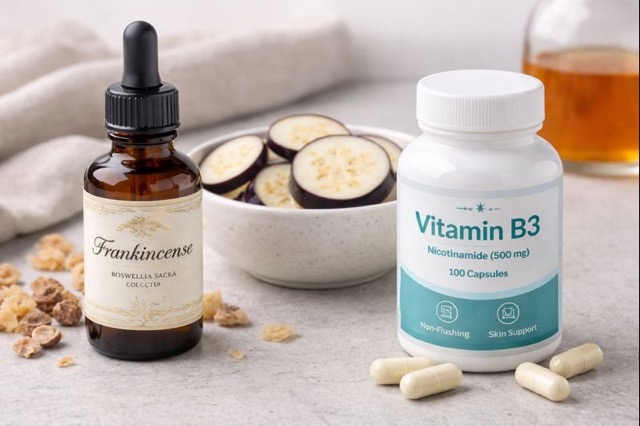
I went to a dermatologist to have a weird fatty thing removed. Of course they tested it and it was benign. But, reason for this post, they always give you a going over, checking for other spots and he was amazed that I had none at my age and he mentioned sun screen. Told him I've never used it and I never burn or even get pink. Why? Because I've been taking the flush niacin for over 20 years. He said that this is a little known fact, that niacin protects from skin cancers but most people refuse to bear the flush. He also said that they are researching now about using niacin in people with aggressive skin cancers and are finding all good results. He then said that good diets are so very helpful, but most people can't be bothered. Niacin that causes flushing is a natural vitamin that we all need.
At only 500 mg/day, taken just before sleep, I hardly feel the flush anymore. Seems like a no-brainer to me.
Apple Cider Vinegar, Baking Soda and Coconut Oil
★★★★★
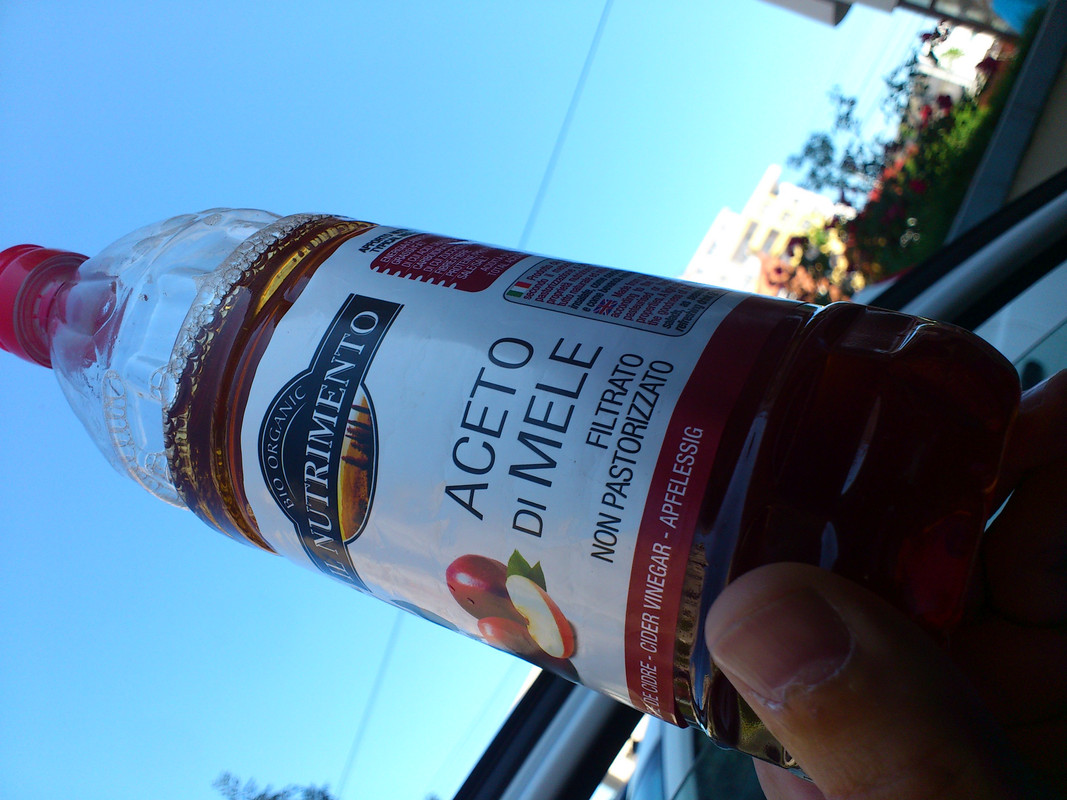
The first time I removed my bcc, I used ACV soaked in a cotton ball and taped it to my BCC every night. After a few days it turned red and after about a month I was BCC free.
The second time I removed my bcc, it was close to my eyes, so I used baking soda with coconut oil 1 tbsp each mixed and made a paste and applied it to the area. After about 2 weeks I was bcc free. I had to deal with scabbing and redness but after that I'm bcc free.
Preventing BCC
★★★★★
If you have sun damaged skin there is good evidence now of usage of vitamin B3 and curcumin (both orally and topically), see Sydney Uni studies etc. They may also work on already established BCCs (even my very left brained doctor told me about trying these). My skin cancers have almost halted since I used these and Vit C in past years.
If you are 'told' to use Aldara, PLEASE google it! I have ended up with Parkinson's disease, unfixable vision loss, shingles/ postherpetic neuralgia (excruciating pain through 2/3 of my body), coeliac disease, skin rashes on chest and neck etc. As severe symptoms happened overnight on my last dose, I can connect the dots easily.
I tell the doctors as I don't want others to suffer, they all go into denial and cover it up (as they have prescribed it often for decades for BCC or genital warts). I post this info on medical websites and it does not get posted (they are 'selective'). I don't want others to suffer :) Better to get cut out if need (the surgeons are pretty good stitchers often! ) Otherwise use Aldara minimally. There are class action court cases.
Apple Cider Vinegar
★★★★★
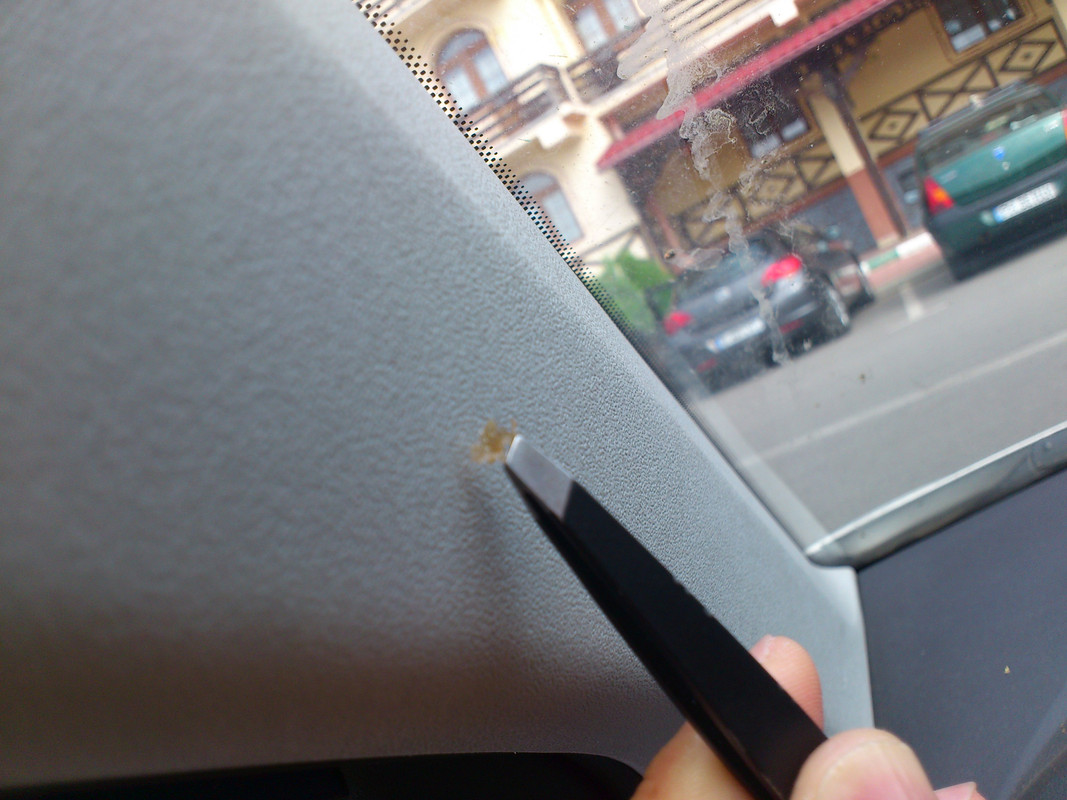
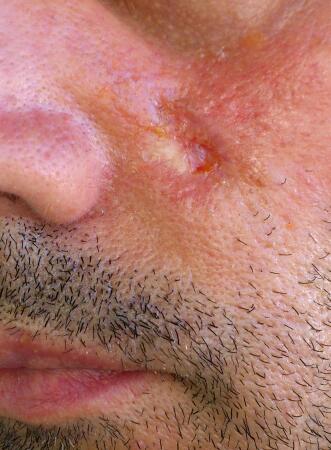
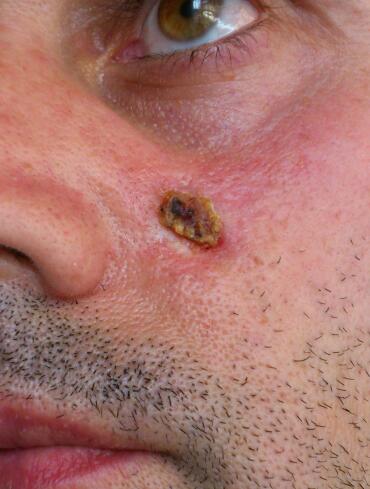
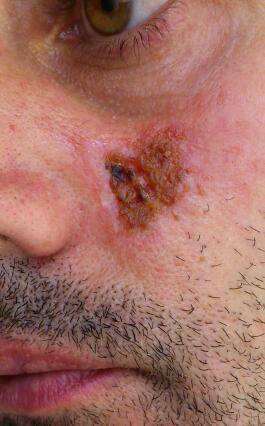
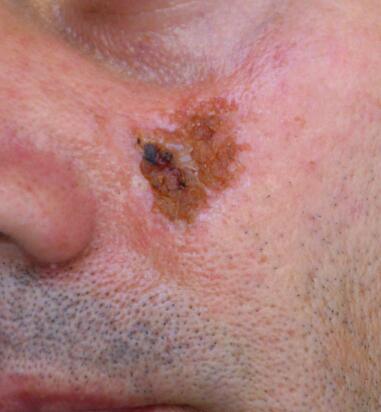
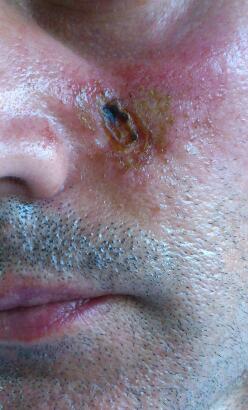
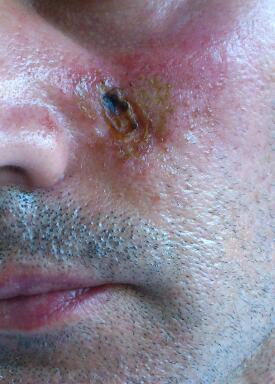
At about the 4th week of treatment, the pink lesion seemed to suddenly become wider. I was frightened, until I read that BCC's can actually run deeper and wider than their surface appearance: BCC's can have deeper tentacle-like structures underneath their surface. Unless all of these "tentacles" of the BCC are removed, the cancer will grow back. So I continued applying the ACV-soaked pads to the bridge of my nose.
By the 7th week of treatment, the bumpy pink lesion flattened out. By then it looked like flat new skin had completely replaced the BCC. Nevertheless, I continued another week of treatment. It looked like the BCC was actually gone, after only 8 weeks! Since then, I have not applied apple cider vinegar to the area, and the BCC has never returned!
Update: May 9, 2017
Although the apple cider vinegar seemed to completely get rid of my BCC, it started to regrow very slowly like a scab three months later (Jan 2017). This time, I did not retreat the BCC with apple cider vinegar. I just ignored it and went on with my life, since it was still very small. However, by April, I decided to try a different treatment. Since I had read that cancers feed off sugar, I began a ketogenic diet (no sugar and no carbs) to try and see if I could starve out the cancer. Within a week, the BCC started to shrink, and within a month the BCC was completely gone! So I have decided to remain on the ketogenic diet for the rest of this summer, just to make sure the cancer does not return. Meanwhile, I have discovered another benefit of the ketogenic diet ... my psoriasis has cleared up!
Apple Cider Vinegar Treatment Photos
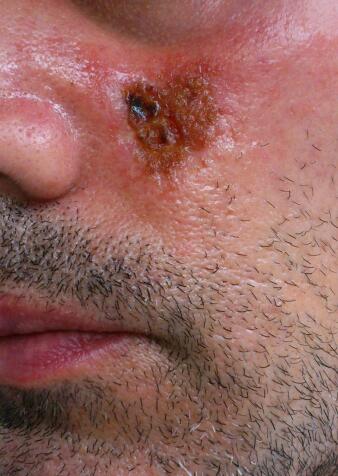


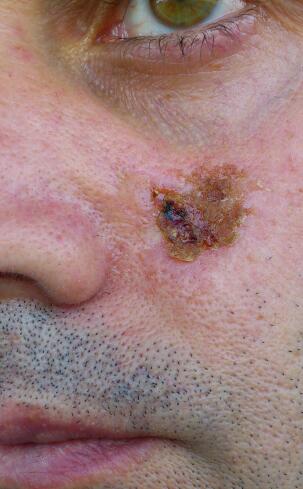


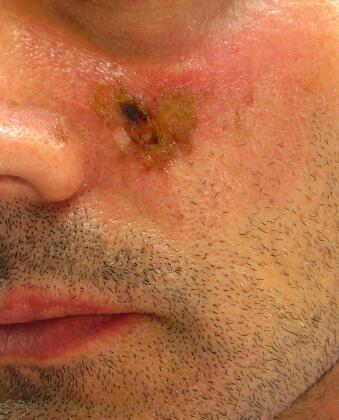


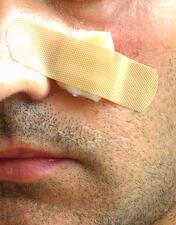




Apple Cider Vinegar
★★★★★
A few years ago, I went to the dermatologist for a small scar on my nose that would repeatedly heal and then bleed if bumped. The doc took one look, made no fuss, and blasted it with liquid nitrogen to freeze it off. I thought this was the end of it, and after a week, all seemed well. It returned. Back to the derm office for another treatment. This time, they prescribed Fluorouracil 5% topical cream, and mentioned something about a possible biopsy if it persisted. The Fluorouracil burned and made the spot red and nasty for weeks. It sort of cured it. Only within the last few months did the lump appear again, and I wasn't feeling visiting the derm office again; so I found Earth Clinic and decided to give Apple Cider Vinegar a go. Here's what I did:
Began on a Friday morning around 9am. I used an organic ACV with "the Mother", cut a cotton ball into small wads to fit across the site. A cotton wad saturated with ACV will stay stationary until it dries. I replaced the wad every hour. After the second hour, as Kate mentioned, the center of the BCC turned black, encircled by a white ring. I followed this procedure for nine hours, changing the wad every hour (fortunately, I work from home, so I didn't have to concern myself about appearances). After 6:30pm on Friday evening, I left the site alone. The scab maintained the dark brown/black center with a white outer rim (beyond that was redness). I woke in the middle of the night, and secured a cotton wad with a bandaid and went to sleep (about five hours).
Saturday morning, I began replacing the wad every hour for four hours. I stopped between 11am through 3pm. Then applied the wad for another four hours until 7pm. The site maintained redness and the scab, the white ring with the black center. Woke up early Sunday morning and for the next five hours replaced the ACV wad every hour again. I also purchased Hydrogen Peroxide 3%, as I read other folks used that as a support, and began dabbing a qtip on the site before replacing the ACV wad on Sunday morning. I stopped from noon through 4pm and began again until 8pm. At this point, the site around the scab became really red and sensitive.
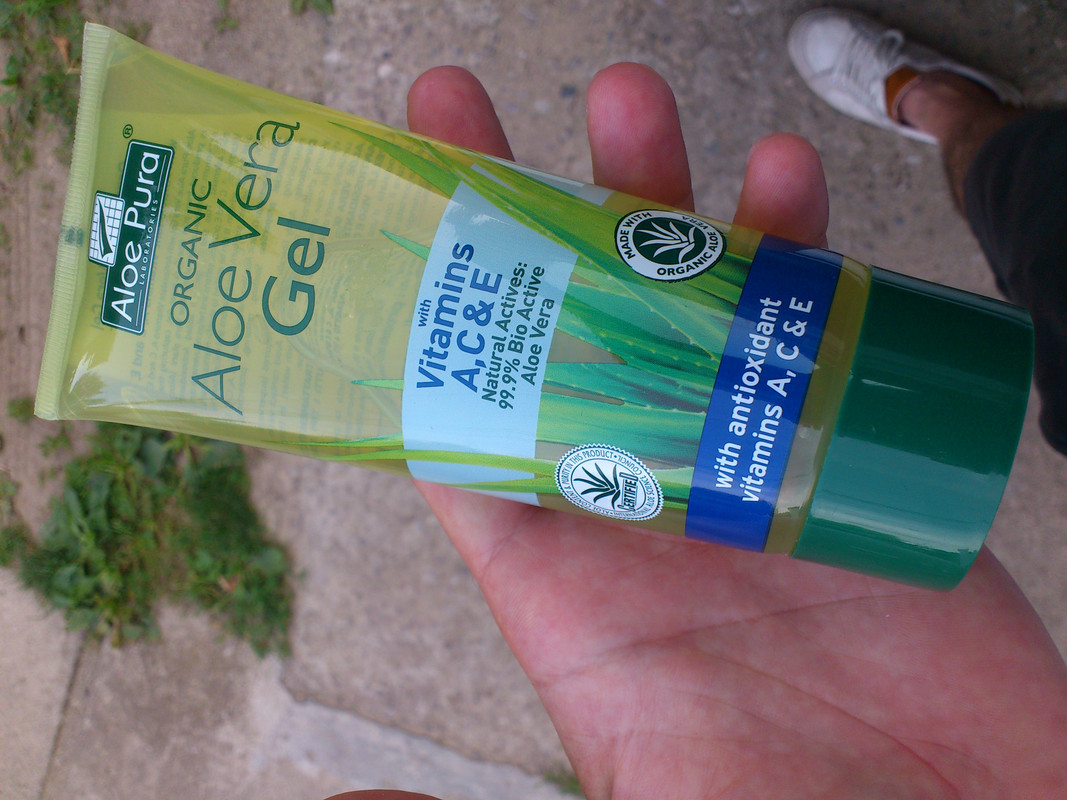
Around 5pm on Sunday afternoon, I began applying an all natural Vitamin E cream and Aloe Vera gel to help with the redness. While applying the cream, I brushed the scar off and it revealed a decent size indentation/hole. The entire site around the indentation was white and outside was red. I had the sense that the ACV did its job and was in the clear. For the next few hours, the ACV really burned/stung. I used the Hydrogen Peroxide 3% very sparingly too.
I was a little concerned, as I was left with a indentation/hole in the center of my nose, but I trusted the process. I also sensed this was the end having to soak a cotton wad in ACV; so I did not use ACV or secure a wad on the site over Sunday night. Monday morning, I began the process of administering Vitamin E and Aloe Vera gel on the site to promote healing, and to reduce the redness. Fortunately, overnight, a whitish (healthy looking) scab formed, covering the indentation/hole which was a comfort. A few other little whitish scars formed around the main site where the BCC was; so from what I read, this must have been "tentacles" that would be no more through this protocol.
I duly persisted a few times a day with the Vitamin E and Aloe Vera gel combo through Wednesday evening, along with some quality organic essential oils with a coconut oil base to cool the redness, as I had them laying around and figure it couldn't hurt. During one application, I brushed off the whitish scab and the indentation/hole was about 97% closed! Also noticed a little flaky skin where a tentacle was. I ever so gently worked it across the site, and it remove a layer of dead skin along with two dark spots, revealing perfectly healthy pink skin underneath! After, I washed my face with a Coconut/Olive oil soap.
Thursday (day 6) and the site, while it is pink due to the new skin, the spot in the center is 99% closed and won't be noticeable, I'm sure in a day or so. Thank you all for sharing your healing process with BCC. I hope my sharing helps others who choose the ACV protocol to assist in their healing.
Stick it out during the first couple days of dealing with skin discoloration, redness and stinging. The second day, when applying the ACV wad, I had a dull nagging headache throughout, which I knew was a result of the ACV getting it done. ACV is magic! I hope you have as much success as I've had with this protocol.
Apple Cider Vinegar
★★★★★
I saw on Earth Clinic people had used Apple Cider Vinegar for this and gave it a try. I had one large white smooth bcc spot which had been resistant to the cream for about 2 years. I started applying organic ACV with a cotton ball to the spot at night before sleeping. The first night I taped the saturated cotton ball onto my forehead, after that I just gently rubbed the ACV on before bed, not rinsing.
After the first two days, the spot opened up and was quite red. I also noticed that in a circular pattern around it, about an inch away, several tiny red spots emerged and formed small scabs. I was a little concerned but continued a few more days, and used a bit of organic coconut oil on it to sooth the redness, and the spot scabbed over (about day 4). After 6 days of this treatment, the scab fell off and I noticed that in the tiny hole which had opened up in the center of the spot, there was a good sized brown waxy ball. I pressed very lightly and the wax ball popped out. Immediately the hole closed up and became almost normal pore-sized, no bump whatsoever! I soothed my whole forehead (the surrounding tiny scabs had also fallen off and left no marks) with the coconut oil and within another day it was as if I had never had a basal cell carcinoma there.
No recurrence either in 4 months - once I had a red mark I thought might develop in a different part of the forehead, but applied the ACV and nothing came of it. This is after years of "chronic" basal cell carcinoma, according to my docs, so I am quite impressed by these results.
Apple Cider Vinegar
★★★★★
I immediately went online to find natural treatment, found this website, and was amazed by what I read.
To the pantry, to the Apple Cider Vinegar.
The biopsy was booked for the end of the month, 18 days away. I thought that maybe by then there may be some improvement.
I used a cotton bud with ACV every hour or so until bedtime, then stuck a small cotton wool pad soaked with ACV on the offending object, and held it on with a band aid. Removed it some time in the middle of the night, been on for 4 hours or so.
The first 2 applications with the cotton bud turned it blackish, and it started to scab. That was last Thursday afternoon.
I continued to repeat the exact process for the next 4 days. By then a scab had formed around the 2mm BCC, so the scab it's self was about 1cm round, with a blackish centre. The edges looked red and angry. The vinegar caused stinging, a little throbbing, none of which lasted more than 10 mins or so, totally bearable, and I'm a wimp with zero pain threshold!
On Tuesday I stopped the vinegar, thought I'd let the scab fall off, then see whats underneath. I gently rubbed an all natural vitamin E cream on the scab and surrounding area a couple of times a day.
Today is Thursday 7 days later. The scab washed off in the shower this morning. Underneath is healthy pink skin, no raised lump, just the tiniest hole where the BCC was. It's gone!!
I'm blown away. I'll keep an eye on it, but it seems to have vanished. I've cancelled the biopsy :)
Hydrogen Peroxide
★★★★★
During the use of the h202, I did notice some slight stinging, off and on, and that it itched. I also read that a vitamin c soln was good for BCC. All I had was a vitamin c tablet, that I let dissolve, and I did use that paste some. (not sure if that helped any, but I did use it a couple days before I started the h202. ) I do believe in prayer and I prayed a lot. I also believe the scripture that says, "My people perish for lack of knowledge. " and I feel God allowed me to find these websites, and He gave me this wisdom. Thank you, Jesus!