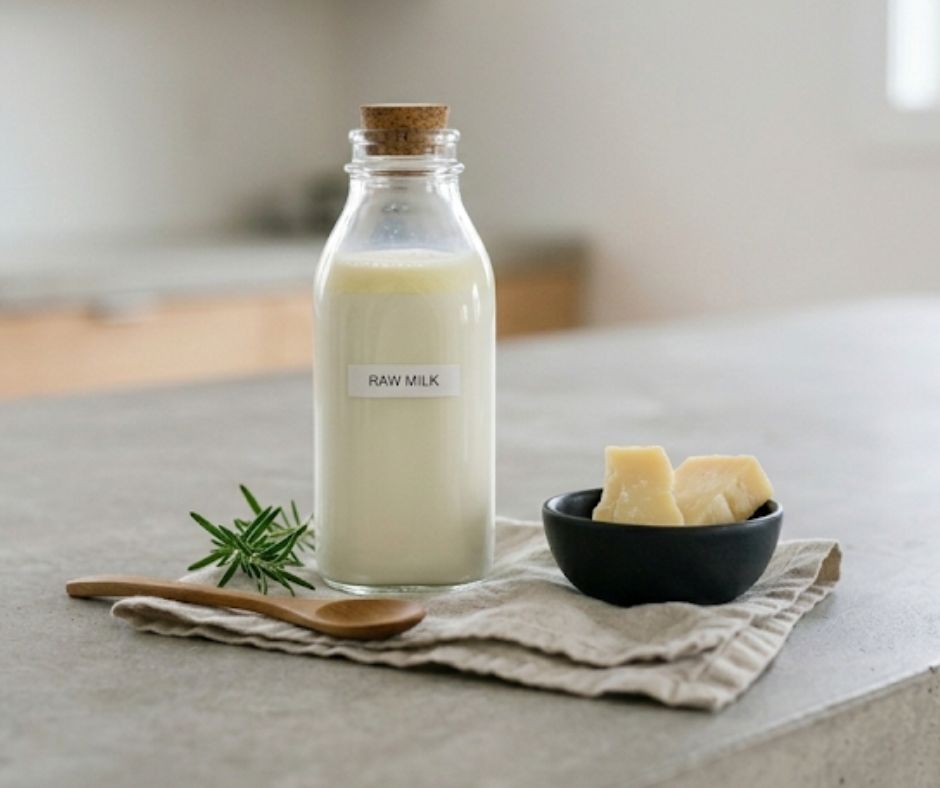
Raw dairy — including raw milk, cream, butter, kefir, and aged cheeses — continues to grow in popularity. Supporters report better digestion, fewer allergies, improved skin, and stronger satiety compared to pasteurized products.
At the same time, raw dairy requires serious respect for food safety, sourcing, and handling. This 2026 Earth Clinic guide covers not just the potential benefits, but the practical “how-to” details most beginners are never told.
Quick Nav:
▸ What Raw Dairy Is
▸ Pasteurization vs Homogenization
▸ Potential Health Benefits
▸ Digestibility & Lactose Clarification
▸ Raw Fermented Dairy Advantage
▸ The “Start Slow” Transition Protocol
▸ Legal Access & Cow Shares
▸ What Questions to Ask Farmers
▸ Transport & Storage Protocol
▸ Risks & Who Should Avoid It
▸ FAQ
What Raw Dairy Is
Raw dairy refers to milk and milk products that have not been pasteurized. It contains naturally occurring bacteria, intact enzymes, unaltered proteins, and unmodified fat globules.
Pasteurization vs. Homogenization (Two Different Processes)
Most people focus only on pasteurization (heat treatment), but homogenization is equally important.
- Pasteurization: Heats milk to destroy pathogens. Alters enzymes and denatures some proteins.
- Homogenization: Mechanically shatters fat globules so cream cannot rise to the top.
Raw milk is not homogenized. You will see a visible cream line at the top — a major selling point for many consumers.
Why the cream line matters: Some advocates believe intact fat globules are digested differently than homogenized micro-fat particles, though research is still evolving.
Potential Health Benefits
- Greater satiety from intact fats
- Natural fat-soluble vitamins (A, D, K2 in grass-fed dairy)
- Conjugated linoleic acid (CLA)
- Omega-3 fats (grass-fed animals)
- Possible immune-modulating compounds (immunoglobulins, lactoferrin)
Some observational studies associate early-life raw milk exposure with lower allergy and asthma rates. However, correlation does not prove causation.
Digestibility & Lactose Clarification
A common misconception is that raw milk contains active lactase. It does not contain significant amounts.
Some people tolerate raw milk better due to:
- Less protein denaturation
- Different fat structure
- Microbial differences
However, those with true lactose intolerance may still react to fluid raw milk.
Raw Fermented Dairy: A Major Distinction
This is where confusion often clears up.
- Raw kefir
- Raw yogurt
- 24-hour clabbered milk
- Aged raw cheeses
In these products, bacteria consume most of the lactose before you ingest it. This explains why someone may not tolerate raw milk but thrive on raw kefir.
Earth Clinic takeaway: If you are lactose-sensitive, start with raw fermented dairy before fluid milk.
The “Start Slow” Transition Protocol
Raw dairy is biologically active. Introduce it slowly.
- Start with 1–2 ounces.
- Increase gradually over 5–7 days.
- Observe digestion, skin, mucus, and energy changes.
Think of it like introducing a new probiotic — not a beverage swap.
Legal Access & The Cow Share Model
Raw milk legality varies widely. In states where retail sales are restricted, many consumers participate in a cow share (or herd share).
In this model:
- You purchase partial ownership of a cow or herd.
- You pay for boarding and care.
- You legally consume milk from your own animal.
This structure bypasses commercial “sales” laws in some jurisdictions. Always verify local regulations.
What Questions to Ask a Farmer (2026 Checklist)
- What are your recent Somatic Cell Count (SCC) numbers?
- What are your Standard Plate Count (SPC) results?
- Do you test for Listeria, Salmonella, and E. coli directly?
- What is your equipment cleaning protocol?
- How quickly is milk cooled after milking?
- Are animals 100% grass-fed or grain-finished?
High-quality farms will answer these confidently and transparently.
Transport & Storage Protocol (Critical)
Raw milk is extremely temperature sensitive.
- Transport: Use a cooler with ice packs. Maintain cold chain below 40°F (4°C).
- Storage: Keep at the back of the refrigerator, not in the door.
- Containers: Use sterile glass jars. Plastic is harder to sanitize and can leach.
- Minimize opening: Repeated warming cycles increase risk.
Risks & Who Should Avoid Raw Dairy
- Pregnant women
- Infants and young children
- Elderly individuals
- Immunocompromised individuals
- People with chronic liver disease
Pathogens such as E. coli, Salmonella, Listeria, and Campylobacter are real risks.
FAQ
Is raw milk more nutritious?
Differences are modest nutritionally, but enzymes and microbial presence differ significantly.
Why does cream rise to the top?
Because it is not homogenized. The visible cream line indicates intact fat globules.
What’s safer: raw milk or raw kefir?
Fermented raw dairy is generally better tolerated due to reduced lactose and active cultures.
Share Your Experience: Tell us whether you use raw milk, kefir, or cheese — how you sourced it, and how you introduced it.